
GHK CU Peptide: Research, Benefits & Dosage Information
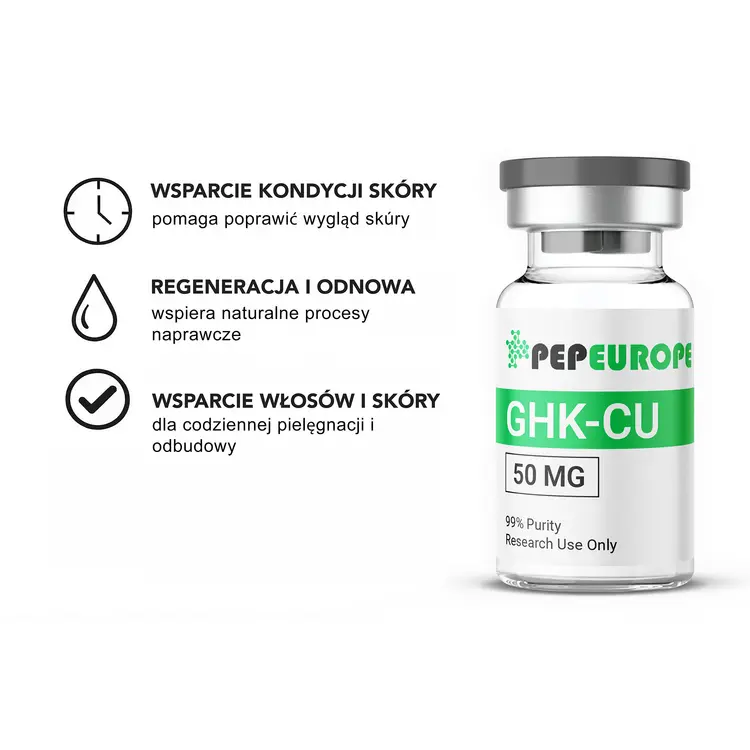
GHK CU peptide is a copper-associated peptide that has attracted considerable interest in peptide research, skincare science and tissue-regeneration research. Also referred to as GHK-Cu, GHKCU peptide, copper peptide or copper GHK-Cu peptide, it is formed when the naturally occurring tripeptide GHK binds with copper ions.
GHK stands for glycyl-L-histidyl-L-lysine, a small peptide that naturally occurs in the human body. Researchers have investigated GHK and GHK-Cu for decades, particularly in relation to collagen production, skin remodeling, tissue repair, inflammation and cellular processes.
For people researching GHK-Cu, it is important to distinguish between established scientific observations, laboratory research, animal studies and human clinical evidence. Although GHK-Cu has a substantial research history, evidence is not sufficient to treat every proposed benefit as an established medical effect.
What Is GHK-Cu Peptide?
GHK-Cu is the copper-bound form of GHK, a naturally occurring three-amino-acid peptide.
The three amino acids that make up GHK are:
- Glycine
- Histidine
- Lysine
GHK has a strong affinity for copper, allowing it to form the copper complex commonly called GHK-Cu. Researchers have studied this complex because copper plays an important role in numerous biological processes, while GHK appears to interact with pathways involved in tissue remodeling and repair.
GHK-Cu is therefore not simply another name for ordinary copper. It is a specific peptide-copper complex that has been investigated for its biological activity.
What Does GHKCU Peptide Mean?
GHKCU peptide is simply another way people commonly write GHK-Cu peptide.
You may encounter several variations when researching this compound, including:
- GHK-Cu peptide
- GHKCU peptide
- GHK Cu peptide
- Copper GHK-Cu peptide
- GHK copper peptide
- Copper tripeptide
- Copper peptide
These terms can refer to the same general GHK-copper complex, although the exact formulation, purity and preparation can vary between research products.
For search purposes, understanding these variations is useful because people researching GHK-Cu do not always use the same spelling or terminology.
How Does Copper GHK-Cu Peptide Work?
Research into GHK-Cu has focused heavily on its interaction with cellular and extracellular-matrix processes.
The extracellular matrix is the structural environment surrounding cells and includes important components such as collagen and glycosaminoglycans. Research has found that GHK-Cu can influence processes associated with collagen synthesis, tissue remodeling and fibroblast activity.
Researchers have also investigated GHK-Cu in relation to:
- Collagen production
- Elastin and extracellular-matrix processes
- Fibroblast activity
- Tissue remodeling
- Skin repair
- Inflammatory pathways
- Oxidative stress
- Angiogenesis
- Wound-healing processes
These mechanisms help explain why GHK-Cu has become particularly interesting in cosmetic science and regenerative research.
However, laboratory findings should not automatically be interpreted as proof of a clinical treatment effect in humans.
GHK-Cu Peptide Research
GHK-Cu has been investigated for many years.
A review published in the biomedical literature describes GHK as a naturally occurring peptide found in human plasma, saliva and urine. Researchers have investigated the relationship between GHK-Cu and processes involved in skin regeneration, collagen synthesis and wound healing.
Additional research has examined GHK-Cu’s potential effects on collagen, elastin, fibroblasts and other components involved in skin structure. Some topical studies have reported improvements in measures associated with skin appearance and elasticity, but the overall evidence base remains smaller than that available for many established dermatological treatments.
More recent reviews continue to identify GHK-Cu as an interesting research peptide for tissue regeneration and skin science, while also highlighting limitations including the relatively small number of large human clinical studies.
Potential GHK-Cu Peptide Benefits
GHK-Cu is often discussed because of its potential biological and cosmetic applications.
Skin and Collagen Research
One of the most researched areas is skin biology.
Laboratory research suggests that GHK-Cu can influence collagen and extracellular-matrix processes. Collagen is an important structural protein involved in skin firmness and tissue structure.
Research has therefore examined GHK-Cu in connection with:
- Skin elasticity
- Skin firmness
- Collagen production
- Skin remodeling
- Fine-line appearance
- Skin barrier processes
- Tissue repair
Some clinical and cosmetic research has investigated topical copper peptide formulations and reported changes in parameters such as skin thickness, hydration, elasticity and wrinkle measurements.
These findings are promising but should be interpreted in the context of the formulation, study design and delivery method being investigated.
Tissue Repair Research
Another major area of GHK-Cu research is tissue repair.
Preclinical research has investigated GHK-Cu in different wound-healing models, including studies involving animals. These investigations have examined processes such as collagen formation, blood-vessel development, inflammation and wound closure.
Because many of these findings come from laboratory or animal models, they should not be interpreted as evidence that GHK-Cu is an established treatment for human wounds.
Antioxidant and Inflammatory Research
Researchers have also investigated GHK-Cu in relation to oxidative stress and inflammatory signaling.
The proposed biological activity of GHK-Cu is one reason the peptide continues to attract attention in regenerative and cosmetic research. However, more human research is needed before many of these mechanisms can be translated into established clinical applications.
GHK Peptide Dosage: What Does the Research Say?
GHK peptide dosage is one of the most frequently searched topics surrounding GHK-Cu.
It is important to make a distinction between a quantity investigated in a laboratory study and a medically established human dose.
At present, there is no universally established or approved systemic human dosage for GHK-Cu. Much of the human research involving GHK-Cu has focused on topical or cosmetic formulations rather than an approved injectable medicine with a standardized dosing schedule.
Research papers may describe concentrations used in laboratory experiments or particular formulations used in cosmetic studies. These numbers should not automatically be converted into an injection dosage or personal treatment protocol.
Anyone considering GHK-Cu for personal medical use should discuss the appropriate options with a qualified healthcare professional.
For research purposes, it is also important to record the experimental model, concentration, route of administration and study conditions rather than treating a research quantity as a recommended dose.
Why GHK-Cu Dosage Can Be Difficult to Compare
Searching for a single “GHK-Cu dosage” can be misleading because studies may use very different approaches.
For example, researchers may investigate:
- Cell-culture concentrations
- Topical formulations
- Cosmetic creams or serums
- Animal-study quantities
- Experimental delivery systems
- Different peptide concentrations
- Different routes of administration
These measurements are not interchangeable.
A concentration used in an in-vitro experiment is not equivalent to a topical human formulation, and an animal-study quantity is not a recommended human dose.
This distinction is particularly important when researching peptides online.
GHK-Cu vs GHK
GHK and GHK-Cu are closely related but are not identical terms.
GHK refers to the tripeptide glycyl-L-histidyl-L-lysine.
GHK-Cu refers to GHK associated with copper ions.
GHK naturally has a strong affinity for copper, and the copper-bound form is the version most commonly discussed in research involving copper peptides and skin biology.
For this reason, searches for “GHK peptide,” “GHK copper peptide” and “GHK-Cu peptide” can sometimes overlap, but the terms should still be used accurately when describing scientific research.
Why Is GHK-Cu Popular in Skin Research?
GHK-Cu has become particularly well known in skincare research because of its relationship with collagen and extracellular-matrix processes.
Studies have investigated whether topical GHK-Cu formulations can influence visible characteristics associated with skin aging.
Research has included measurements related to:
- Skin firmness
- Elasticity
- Hydration
- Wrinkle appearance
- Skin thickness
- Collagen production
- Skin remodeling
A clinical study discussed in a scientific review investigated topical GHK-Cu delivered in a nanolipid formulation over eight weeks and reported improvements in several wrinkle-related measurements.
However, results from individual studies should be considered alongside the broader evidence rather than treated as guaranteed outcomes.
GHK-Cu and Hair Research
GHK-Cu has also attracted interest in hair and follicle research.
Laboratory and preclinical research has investigated GHK-Cu in connection with hair follicles and cellular signaling. Some reviews describe observations involving hair growth and follicle-related processes.
However, evidence in this area is not sufficient to present GHK-Cu as an established treatment for hair loss.
This is another example where promising laboratory findings should be separated from clinically established therapies.
GHK-Cu Quality and Research Considerations
When researching any peptide, quality and documentation are important considerations.
Researchers and laboratories may evaluate factors such as:
- Peptide identity
- Purity
- Batch consistency
- Analytical testing
- Storage conditions
- Packaging
- Documentation
- Manufacturing standards
For a European research audience, clear product information and responsible communication are particularly important.
PEP Europe should avoid making unsupported therapeutic promises and instead provide transparent information about the nature of its research products, available documentation and intended use.
GHK-Cu in the European Market
Interest in peptide ingredients has expanded across the European cosmetic and research markets.
However, businesses should distinguish between cosmetic ingredients, research materials and medicinal products.
The European Commission’s CosIng database provides information about cosmetic ingredients, but the Commission specifically notes that the database is informative and does not itself constitute legal approval or determine whether an ingredient may be used in a cosmetic product. Applicable requirements are established under the EU Cosmetics Regulation and its annexes.
For this reason, European-facing content should avoid suggesting that the presence of an ingredient in a database automatically means that every possible use is authorized.
Frequently Asked Questions About GHK CU Peptide
What is GHK CU peptide?
GHK CU peptide, commonly written GHK-Cu, is a copper-associated form of the naturally occurring tripeptide glycyl-L-histidyl-L-lysine. It has been researched for its potential involvement in collagen production, skin remodeling and tissue-repair processes.
Is GHKCU peptide the same as GHK-Cu?
Generally, yes. GHKCU peptide is commonly used as an alternative way of writing GHK-Cu. The exact formulation and product specifications should still be checked when comparing individual research products.
What is copper GHK-Cu peptide?
Copper GHK-Cu peptide refers to the copper-associated form of the GHK peptide. GHK has a strong affinity for copper and forms the complex commonly known as GHK-Cu.
What are the potential benefits of GHK-Cu?
Research has investigated GHK-Cu in relation to collagen production, skin remodeling, elasticity, tissue repair, inflammatory processes and oxidative stress. However, evidence varies depending on the application, and many findings remain preclinical.
What is the GHK peptide dosage?
There is no universally established or approved systemic human dosage for GHK-Cu. Research quantities vary according to the experimental model and delivery method, so research concentrations should not be treated as personal dosing instructions.
Is GHK-Cu a copper peptide?
Yes. GHK-Cu is commonly described as a copper peptide or copper-binding peptide because GHK forms a complex with copper.
Is GHK-Cu researched for skin?
Yes. Skin biology is one of the main areas of GHK-Cu research. Studies have examined collagen synthesis, fibroblast activity, skin remodeling and various measures of skin appearance.
Is GHK-Cu an approved medicine?
GHK-Cu should not be presented as an approved medicine simply because it has been studied scientifically. Its regulatory status depends on the specific product, formulation, intended use and jurisdiction.
Final Thoughts on GHK CU Peptide
GHK CU peptide remains an interesting subject within peptide, cosmetic and regenerative research. Its copper-binding characteristics and biological activity have led researchers to investigate its relationship with collagen, fibroblasts, tissue remodeling, skin repair and other cellular processes.
The strongest SEO opportunity for a European audience is to provide accurate, transparent information rather than relying on exaggerated claims. Covering the terms GHK-Cu peptide, GHKCU peptide, GHK peptide dosage and copper GHK-Cu peptide within a well-structured research-focused page can help PEP Europe build topical relevance around the subject while giving visitors useful information.
Because research continues to develop, readers should distinguish laboratory findings, animal research, topical cosmetic studies and established human clinical evidence. GHK-Cu should not be treated as a substitute for professional medical advice or an approved medical treatment.
Research-use notice: Products described by PEP Europe should be presented according to their specific intended use and applicable laws and regulations. This information is educational and does not constitute medical advice, diagnosis or a recommendation for personal treatment or dosing.
Reviews
There are no reviews yet.